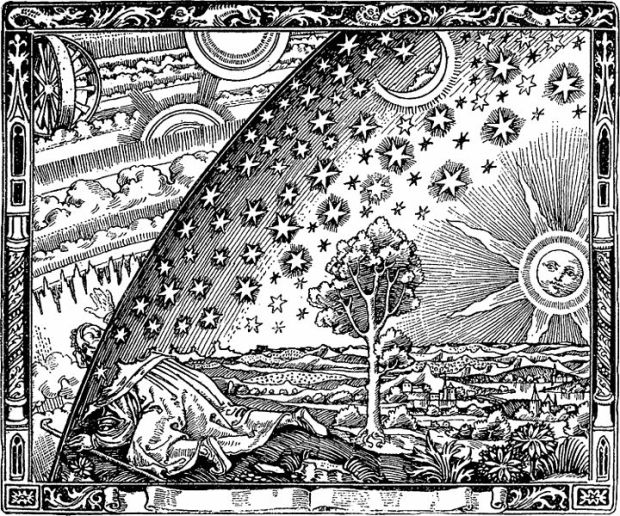
“It is wrong to think that the task of physics is to say how nature is. Physics concerns only what we can say about nature” – Niels Bohr
There is nothing you can see that isn’t shown – The Beatles
 Of the multitude of things that we can say of it, first and foremost: Consciousness is narrative. In other words – it is a telling… Whereby (in the manner of speaking) one could even say – what it “is”, is what it does – simply because without it, one would not be able to “say” anything at all. And as the telling is its hallmark (being someway true to form) – as the self-referring story of a self-aware perception – it’s also nothing but a “tale” that’s someway told.. Such that likewise as “it is” – as with “being” to “becoming” – both are somehow true at any single time… And unless we blithely overlook it – its “truth” is (none could argue): It is the mean of every means … With its capacity to describe, it is the consequential “thing” by which all things can be spoken of; it is the universal arbiter of that metric we call language, the “measure” of our kind – which clothes its very nakedness in the fashion of the day – by apportioning the void in ways that we see “fit”.
Such that while referring to “itself” (as so it’s wont to do), what might seem so curios for “us all” (about this consciousness of ours ) – perhaps is simply this.. That as you’d take the bit of time to someway “think”: To the mind’s eye (which is the “image” that is conjured – by our mind) – this so-called telling of a tale (that’s someway told) – “looks” something like a picture in a story of a journey… In other words – as it is “pictured” in our mind’s imagin-ation – conscious “ness” is a storied journey… And to the mind’s “I” – being conscious – is a lot like being in a moving vehicle, with “us” as its passenger; a panorama that’s replete with an observer in the frame, with a land-scaped horizon, within a constantly unfolding yet ever-present kind of moving “motion picture”.
While on the other hand – as the vessel of our consciousness, one could even say that from the mind’s eye (view) unto its own “naked” vantage (being somehow like our picture in its “mirror”): As we travel through its landscape (while it moves toward that “horizon”) – what is “seen” to be “the world” may in fact be little more than but its momentary portrait. So that like a picture in a story of a journey, it would be little more than just a moment-to-moment snapshot or a shifting point (of view). ONE that makes its time – referring to itself (that is ). Being “all at once” (while seeming “as it were”); little more than a series of moving pictures – viewed from a kind of stage.
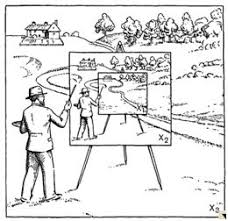
Were one to even further “make” the point: By appearing to itself in such a manneristic way – “appearing” to be a projection of its own imagin-ation (being some “thing” like a mirror, that is); from the mind’s eye view (to its own peculiar vantage) – this continuum we call consciousness appears to frame a snapshot of its twist and turning path. Which somehow means it’s “framed” in such a way – as if (it was) the telling of our story, was nothing but a portrait – of a momentary picture of its journey (which also means – it’s only just a tale that’s someway told )… So as you’d take the bit of time we’d need to picture it: Within the “circle” of our mind’s “imagin-ation” – it might seem somehow all at once – something like the story of a wheel upon an axis… Such that “relatively” speaking (being always relative to itself, that is) – like a tale that is told – it is always looking outward from a certain inner point – while it’s always looking-in from some periphery… And being “in” and of “itself” (as a whole does to its part) – by being “shaped” the way it is – by “appearing” to itself in such a way (like the journey of a wheel upon its axis ) – and as the “vessel” of our consciousness: Being somehow for the moment with a “certain point” of view, picturing the world upon its momentary course – would be a “snapshot” of the circle (that’s “its path”).
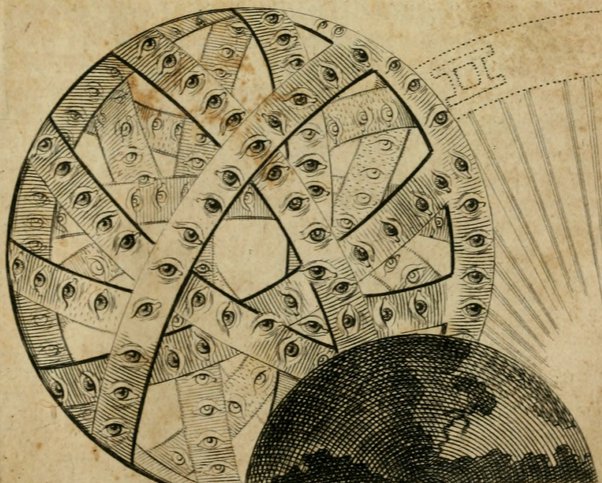

And should you find that “bit” of time one needs to think about it (consciousness, that is): In its kind of odd peculiar way (in a sort of “fashion” of its “own”) – it somehow paints the picture of a “portrait” – of its journey; a strange & curios trip. As if (it was) we’re traveling down that “road” as through some riddle in a plot-line – chasing our very own “tale”; it would appear to be “pur-suing” its very own narrative. While doing it in such a way – that like a “you” or “me” – it makes a reference to itself.
SO WELCOME BACK MY FRIENDS to the show that never ends... Welcome to the Labyrinth.
Without its ever-ending story – there is no “tail” to be told. 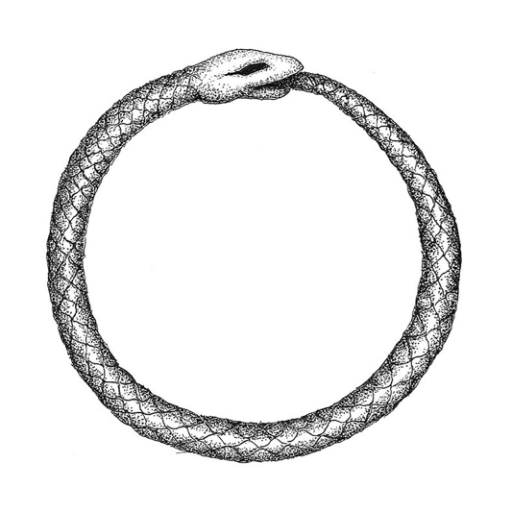
Continue on to Chapter 3: LANGUAGE AND ITS GAME OF WORDS
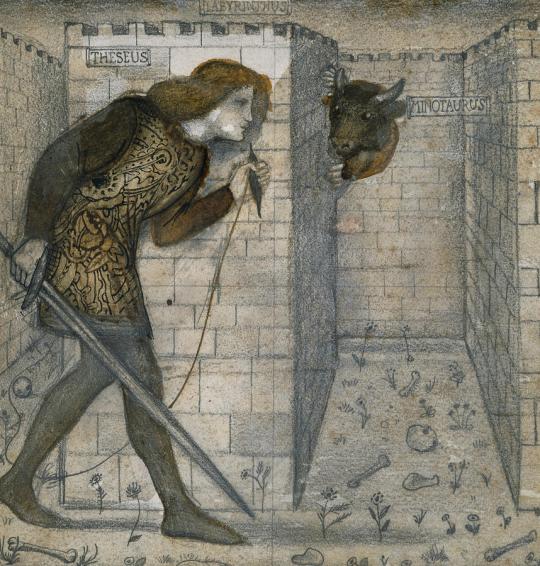
Theseus and the Minotaur, Edward Burne-Jones 1861

