Ainsoph, this upright One, with that noughty besighed him zeroine… To see in his horrorscup he is mehrkurious than saltz of sulphur.
– James Joyce, Finnegan’s Wake (261.23-26)
PREGNANT WITH A MEANING
“The medium is the message” – Marshall Mcluhan
In his “Le Mystère Des Cathédrales” – Fulcanelli introduces the enigmatic term “Cabala” (to be distinguished & juxtaposed with the Hebrew Kabbalah) as a way to refer to a special category in the use of common language. Derived from the Latin root “caballus” (meaning horse, as with the Spanish word caballo), Cabala (as he describes it, however similar to the ear as the Hebrew Kab-balah) is “an arcane Latin term possessed of rich and vivid history”.. According to his narrative – this Cabala should be regarded as a kind of “horseplay” or Tom foolery; a homo-phonic form of lexical assonance which he calls “a parley or dalliance”, one whose very form or substance could be someway characterized to have a spirited “life of its own”.. Fulcanelli further goes on to write that this so-called horseplay (Cabala) has been known at other times and other places by other names and that together as a whole – they can all be somehow characterized by a certain inclin-ation towards an “oblique” style and free-form play on words. He further assures that the style in which “it speaks” is clearly recognizable – if one has “eyes to see or ears to hear”. And further still – that this Cabala was not only just a spirited play of words, but could be equally character-ized as a special form of cant or argot: A proverbial “slang of ages”. *
As if all roads lead thru Rome Fulcanelli goes on to compare (this) Cabala to (that) Kabbalah by claiming it to be the more universal of the two – placing the former firmly under the rubric of a “phonetic cipher”. And when it is at play – “acting” (on the one hand) as a hermeneutic tool, while performing (as the other) as a common thread of elementary meaning (much in the manner of a Rosetta stone) – it comes to someway “re-present” that essential “thing” which both frames and circumscribes the fundamental unity of every form of language; drawing upon word similarities and semantic assonances (such as homophones, puns, polysemes, and tropes) while employing them as “symbolic tools for expanding the expressive reach of words”. Being much like the free-form style of modern day hip-hop, techniques falling under its rubric have been known at other times (cloaked in legendary guises) through such effervescent titles as the Langue Verte of the Hermetic alchemists, the twilight language of tantric Buddhism, or those fabled winged words of song renown of bards like Homer – or what some might call the language of the birds.
The author further goes on to say that as a hermeneutic tool, the phonetic Cabala is a short-hand way to understand the “gist” of alchemical texts and symbols – and that when combined with the study of word roots (etymology) “it can configure the mind in such a way to have an ev-er deepening and richer set of associations from which to draw, while expanding the semantic space open for contemplation”. He further writes that this broadened expansion of the faculty of language can reverse the “Babel effect” of the confusion of the tongues “by connecting to a level of mind (or of unity ) from which individual languages are but partial projections”.
“Beware of Greeks bearing gifts” – Virgil

NOW RIDDLE THIS: 
A Concealment of Concealment
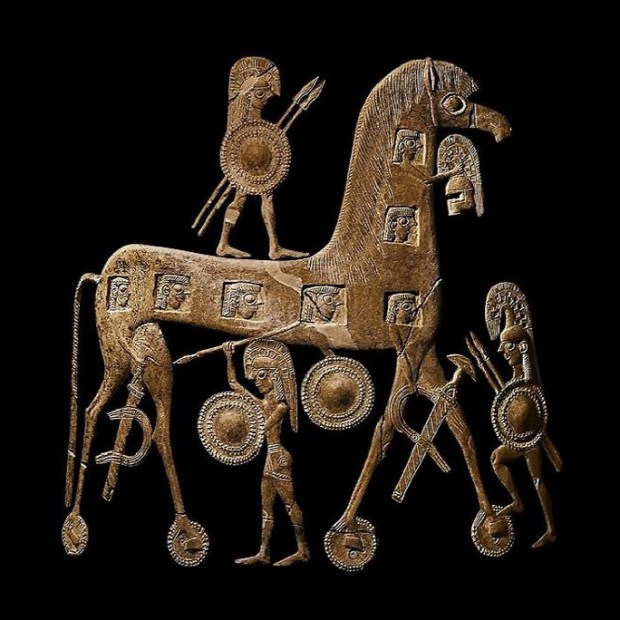
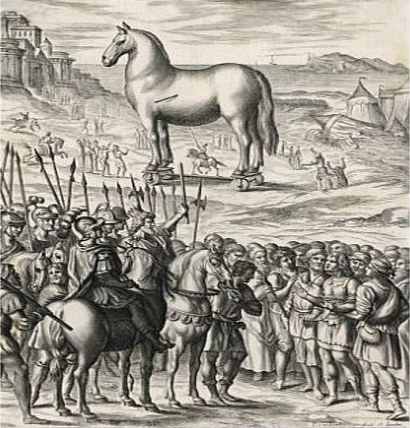
Finally – it is through the logic and example of this “horseplay” (or Tom foolery) that Fulcanelli leans deeply into the storied meme of the Trojan Horse – characterizing the timeless epic tale as a symbol (or the sign) of “a recursive pun which ‘masquerades’ itself as a veiled metaphor”…
Which would also mean to say: That as a thing – as a “token” or the “sign” for the hidden carrier of meaning (i.e. somehow as its object or its icon) – our “polytropic” horse delivers its semantic payload much like the rebus or a palindrome; referring back onto itself in ways which are both oblique as well as obvious… Much as would the notion of an “embedded” concept be some way assonant – to a thing that’s somehow “pregnant” with (a) meaning.

Continue to Chapter 7: DRAGON OF THE ECLIPSE
 the telos of history
One comment